Medical Imaging / Deep Learning
Brain Tumor Segmentation using 3D Deep Learning
BraTS 2023
Overview
This research project investigates automated brain tumour segmentation from multimodal MRI scans using 3D deep learning models. Experiments compare multiple U-Net variants under a consistent training and evaluation workflow, with results interpreted through Dice-based region metrics, HD95, and qualitative prediction examples.
Model Variants
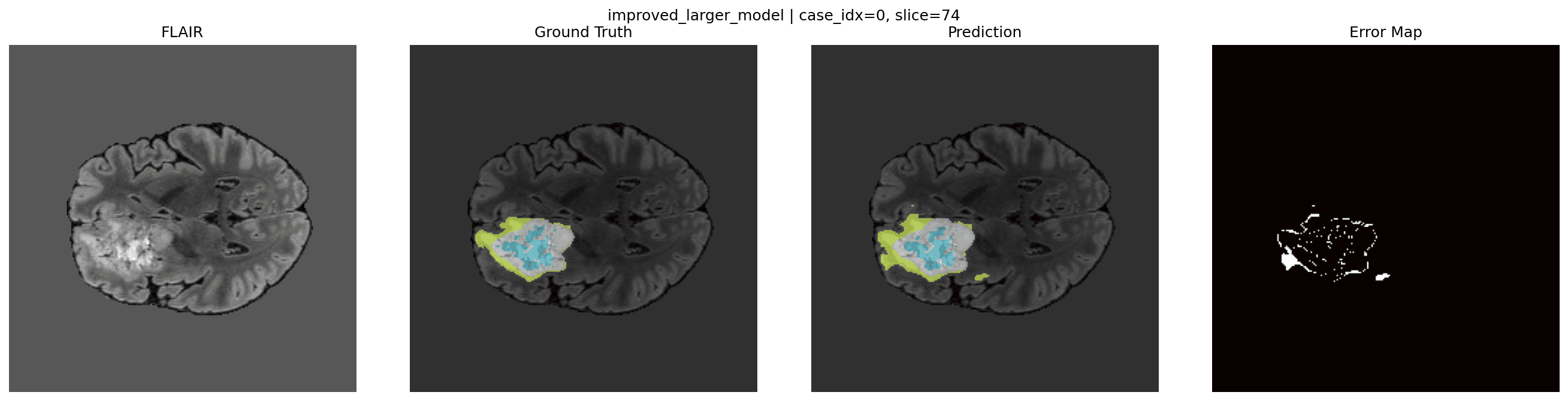
Improved Larger MONAI U-Net
A stronger baseline model used for comparison across matched seeds.
Attention Gate U-Net
A model variant introducing attention gates, showing slightly higher mean Dice but greater seed sensitivity.
SE Bottleneck U-Net
A bottleneck ablation with squeeze-and-excitation style components, treated as a negative ablation in current experiments.
Results
| Model | Seeds | Mean Dice | ET Dice | TC Dice | WT Dice | Interpretation |
|---|---|---|---|---|---|---|
| Improved Larger U-Net | 3 | 0.8721 ± 0.0046 | 0.8297 | 0.8837 | 0.9029 | Strong baseline |
| Attention Gate U-Net | 3 | 0.8736 ± 0.0066 | 0.8303 | 0.8810 | 0.9095 | Slightly higher mean, less stable |
| SE Bottleneck U-Net | 1 | 0.8592 | 0.8135 | 0.8606 | 0.9036 | Negative ablation |
The Attention Gate U-Net achieved a slightly higher 3-seed mean Dice than the improved larger U-Net, but with higher seed sensitivity. Therefore, the current result is treated as an in-progress finding rather than a stable improvement claim.
Visual Examples
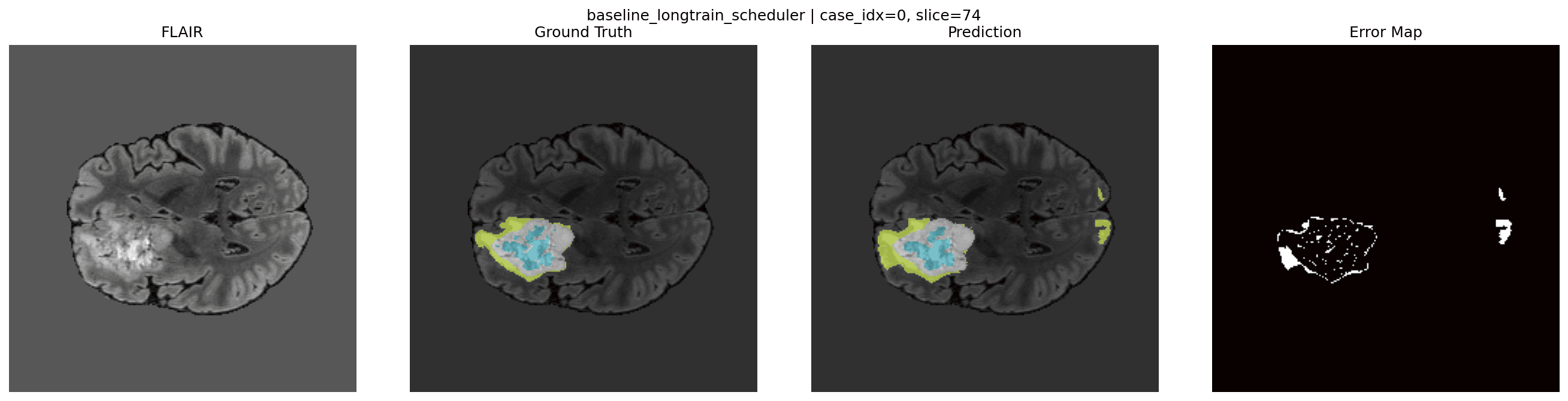
Qualitative examples compare FLAIR input, ground truth, prediction, and error-map style views where available.
My Contribution
- Developed and evaluated 3D deep learning models for automated brain tumour segmentation using multimodal MRI data from the BraTS 2023 challenge dataset.
- Implemented end-to-end preprocessing, training, and evaluation pipelines applying PyTorch and MONAI for volumetric medical imaging analysis.
- Assessed segmentation performance using Dice Score and Hausdorff Distance metrics across tumour subregions.
- Investigated model robustness and optimisation strategies while managing large-scale biomedical imaging datasets.
Evaluation / Outputs
- Dice-based region metrics
- HD95
- Qualitative prediction examples